For years, car buyers in India mostly focused on mileage, features, and design. But today, one factor is changing the entire buying decision — safety.
Now, more people are checking whether a car has a 4-star or 5-star safety rating before purchasing. But how do these ratings actually work? Is a strong body enough, or is there much more happening behind the scenes?
Here’s a simplified look at how modern car safety testing works.
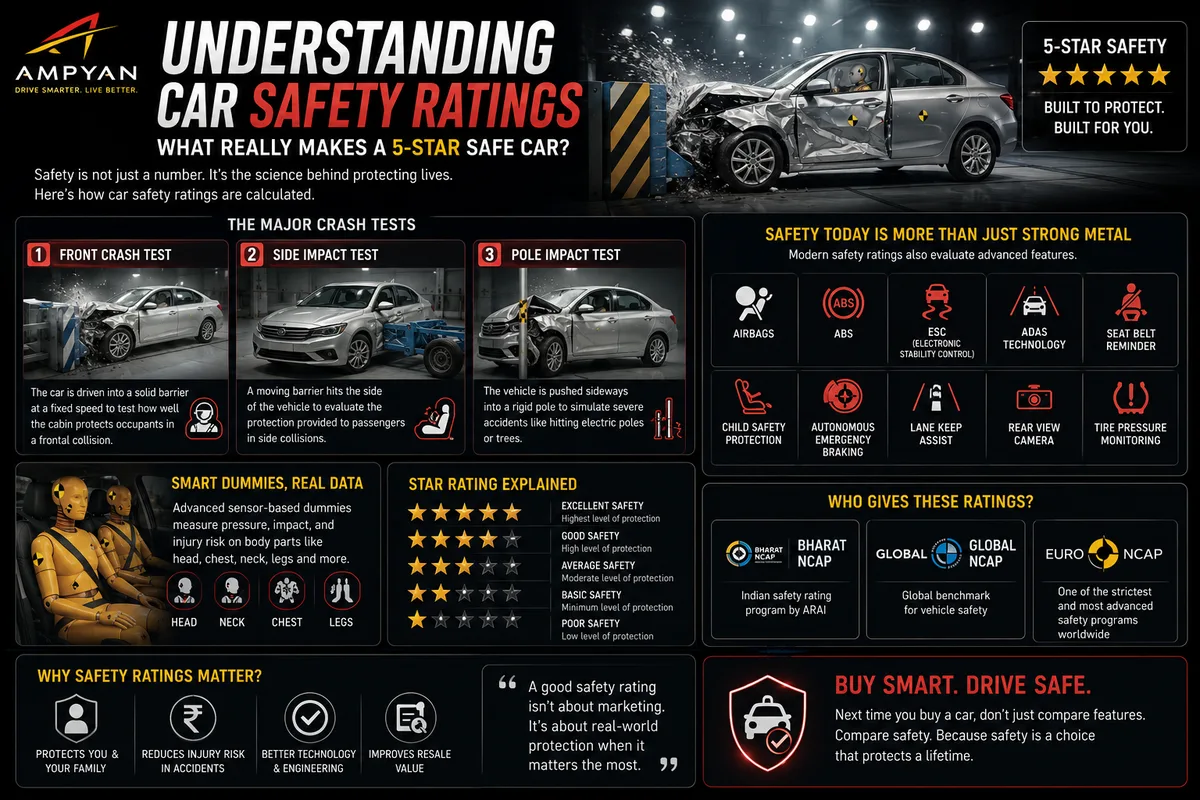
The Front Crash Test
This is one of the most important safety evaluations. During the test, the vehicle is driven into a solid barrier at a fixed speed to study how well the cabin protects passengers during a frontal collision.
Engineers analyze:
* Cabin deformation
* Airbag deployment
* Steering movement
* Injury risk to occupants
Side Impact Test
In this test, a heavy moving barrier crashes into the side of the car. The goal is to understand how much protection passengers receive during side collisions, which are usually more dangerous due to limited space between the passenger and impact point.
Pole Impact Test
This is considered one of the toughest crash tests.
The car is pushed sideways into a rigid pole to simulate severe real-world accidents like hitting electric poles or trees. This test checks:
* Structural rigidity
* Curtain airbag performance
* Head protection capability
Smart Dummies, Not Ordinary Mannequins
Crash-test dummies used today are highly advanced sensor-based systems.
They measure:
* Pressure on body parts
* Neck movement
* Chest impact
* Leg injury possibility
* Head trauma risk
These readings help agencies calculate how safe the vehicle really is for humans during accidents.
Safety Today Is More Than Just Strong Metal
Earlier, people believed “heavy body means safer car.” But modern safety standards go far beyond body strength.
Today’s ratings also evaluate:
* Airbags
* ABS and ESC
* Seatbelt reminders
* Child safety systems
* ADAS features
* Emergency braking systems
* Lane assist technologies
A car with modern active safety systems can sometimes avoid accidents before they even happen.
Who Gives These Ratings?
Several global organizations evaluate vehicle safety:
* Bharat NCAP
* Global NCAP
* Euro NCAP
Among them, Euro NCAP is widely considered one of the strictest testing programs in the automotive industry.
Why Safety Ratings Matter
A safety rating is not just a number for marketing.
It reflects how well a vehicle can protect you and your family during critical situations. In real-world accidents, better structural engineering and smarter safety systems can make a life-saving difference.
That’s why modern buyers should not look only at sunroofs, touchscreens, or mileage figures. Understanding a car’s safety performance has become just as important as performance or styling.
Because in the end, the safest feature in any car is the one that protects lives.