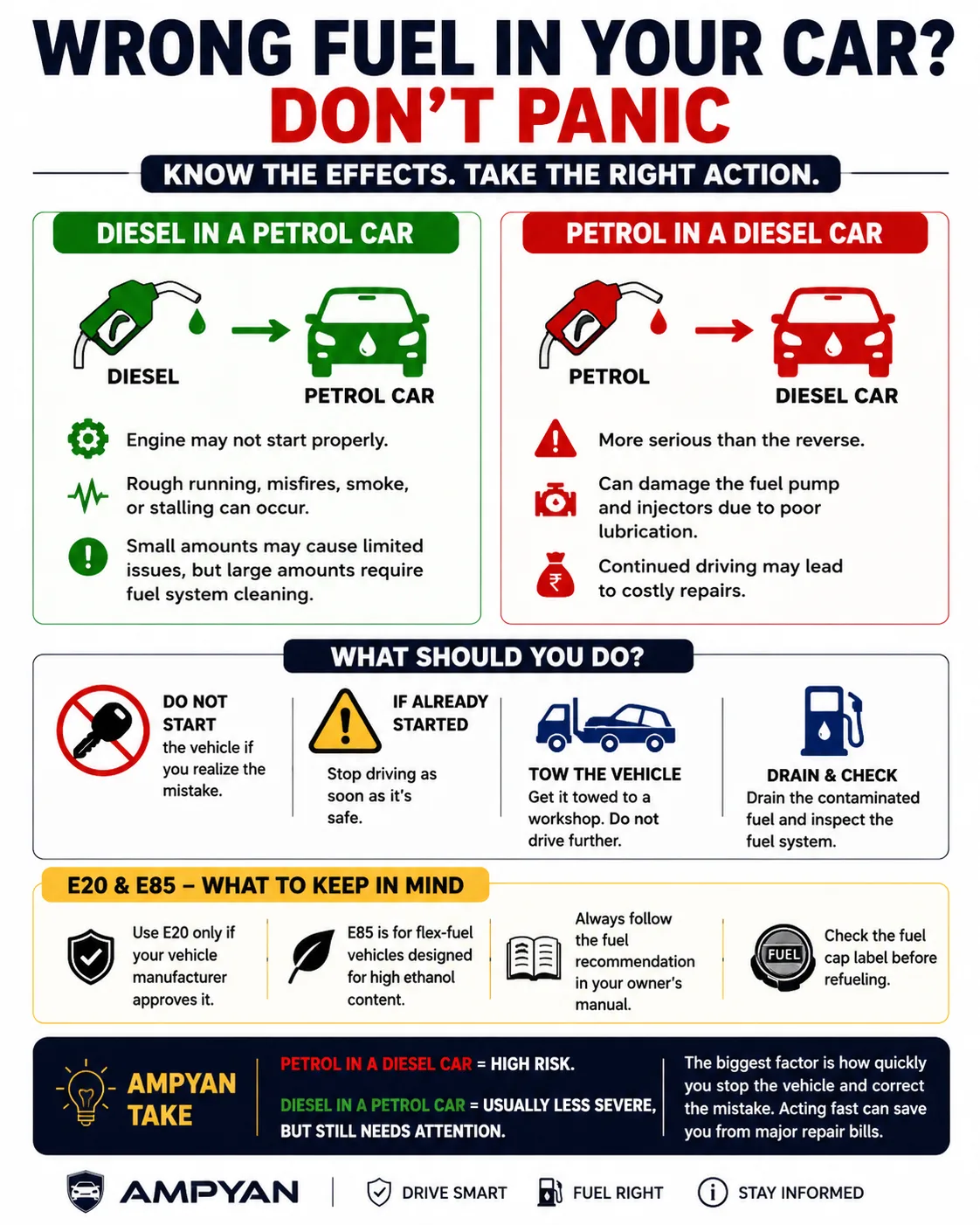
With fuels like E20 and E85 becoming more common, many vehicle owners are confused about fuel compatibility. However, one of the most common mistakes at fuel stations is still filling the wrong fuel type into a vehicle. So, what happens if diesel is accidentally filled into a petrol car, or petrol is filled into a diesel car? Let’s break it down.
What Happens If Diesel Is Filled Into a Petrol Car?
Petrol engines rely on spark plugs to ignite the air-fuel mixture, while diesel behaves differently during combustion. If diesel enters a petrol vehicle’s fuel system, the engine may struggle to burn the fuel efficiently.
Possible Symptoms:
* Difficulty starting the engine
* Rough idling and misfires
* Reduced performance
* Excessive smoke from the exhaust
* Engine stalling
If only a small amount of diesel is mixed with a large quantity of petrol, the impact may be limited. However, a higher concentration of diesel can require fuel system cleaning and inspection.
What Happens If Petrol Is Filled Into a Diesel Car?
This is generally the more serious situation.
Diesel fuel not only powers the engine but also lubricates critical components such as the high-pressure fuel pump and injectors. Petrol has much lower lubricating properties.
Possible Consequences:
* Damage to the high-pressure fuel pump
* Injector wear or failure
* Rough engine operation
* Increased internal friction
* Expensive fuel system repairs
Modern common-rail diesel engines are particularly sensitive to petrol contamination.
What Should You Do If You Realize the Mistake?
If the Vehicle Has Not Been Started:
✅ Do not start the engine.
✅ Avoid switching the ignition on repeatedly.
✅ Arrange for the vehicle to be towed to a workshop.
✅ Drain the fuel tank and inspect the fuel system before driving.
If the Vehicle Has Already Been Driven:
✅ Stop the vehicle as soon as it is safe.
✅ Avoid further driving.
✅ Contact roadside assistance or a qualified technician immediately.
What About E20 and E85?
* Use E20 only if your vehicle manufacturer approves it.
* E85 is intended for flex-fuel vehicles specifically designed to handle high ethanol content.
* Always follow the fuel recommendation mentioned in your owner’s manual.
* Check the fuel cap label before refueling.
AMPYAN Verdict
A wrong-fuel incident does not always mean engine failure. The severity depends on the type of fuel, the quantity involved, and whether the vehicle was started or driven afterward. In most cases, acting quickly can prevent major damage and save significant repair costs.