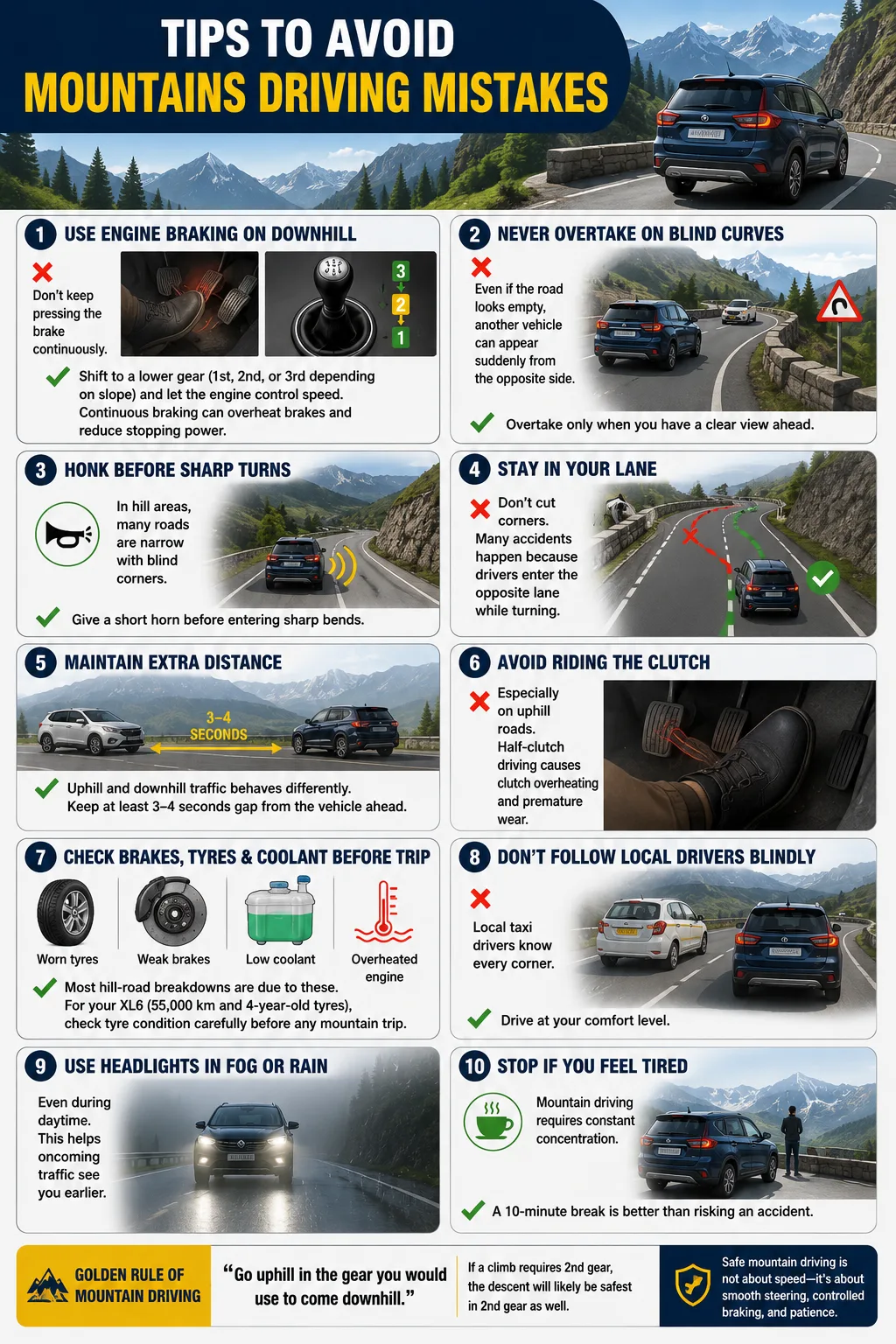
1. Use Engine Braking on Downhill
❌ Don’t keep pressing the brake continuously.
✅ Shift to a lower gear (1st, 2nd, or 3rd depending on slope) and let the engine control speed.
Continuous braking can overheat brakes and reduce stopping power.
⸻
2. Never Overtake on Blind Curves
Even if the road looks empty, another vehicle can appear suddenly from the opposite side.
✅ Overtake only when you have a clear view ahead.
⸻
3. Honk Before Sharp Turns
In hill areas, many roads are narrow with blind corners.
✅ Give a short horn before entering sharp bends.
⸻
4. Stay in Your Lane
❌ Don’t cut corners.
Many accidents happen because drivers enter the opposite lane while turning.
⸻
5. Maintain Extra Distance
Uphill and downhill traffic behaves differently.
✅ Keep at least 3–4 seconds gap from the vehicle ahead.
⸻
6. Avoid Riding the Clutch
Especially on uphill roads.
❌ Half-clutch driving causes clutch overheating and premature wear.
⸻
7. Check Brakes, Tyres & Coolant Before Trip
Most hill-road breakdowns are due to:
* Worn tyres
* Weak brakes
* Low coolant
* Overheated engine
For your XL6 (55,000 km and 4-year-old tyres), check tyre condition carefully before any mountain trip.
⸻
8. Don’t Follow Local Drivers Blindly
Local taxi drivers know every corner.
✅ Drive at your comfort level.
⸻
9. Use Headlights in Fog or Rain
Even during daytime.
This helps oncoming traffic see you earlier.
⸻
10. Stop if You Feel Tired
Mountain driving requires constant concentration.
A 10-minute break is better than risking an accident.
⸻
Golden Rule of Mountain Driving
“Go uphill in the gear you would use to come downhill.”
If a climb requires 2nd gear, the descent will likely be safest in 2nd gear as well.
Safe mountain driving is not about speed—it’s about smooth steering, controlled braking, and patience. 🚗⛰️